
AI website builders promise a finished site in minutes. Type a prompt, pick a color, and a homepage appears with a hero photo, a tagline, and a contact form. For a busy real estate agent juggling showings, inspections, and late-night offer negotiations, that pitch is hard to ignore.
And to be fair, the technology is impressive. AI can write a paragraph, lay out a page, and suggest a font pairing faster than any human. If all you need is a digital business card, it might even be enough.
But a real estate website isn’t a business card. It’s a lead engine, a property search tool, and a credibility check all rolled into one. The parts that make a real estate site actually work are exactly the parts AI builders handle worst. Here’s why most agents are better off leaving their website to people who build real estate sites for a living.
1. AI Doesn't Know Real Estate. Real Estate Professionals Do.
AI builders work by predicting what a typical website looks like. They can produce a clean layout, but they have no idea how buyers actually shop for a home, what makes a seller pick up the phone, or what your market cares about. They’ve never held an open house, negotiated a repair request, or followed up with a lead for eight months before it finally closed.
Working with a team that’s in the industry changes the whole conversation. When your web partner also practices real estate, they know which pages buyers and sellers actually use, which calls to action turn visitors into appointments, and how a website fits into your day-to-day business. You don’t have to explain what IDX is, why your brokerage information belongs on the site, or why a home valuation lead needs different follow-up than a buyer lead.
A professionally built site starts from you, not from a prompt. It begins with your market, your niche, and your voice, and then shapes the site around them. Your edge is local and personal: knowing which subdivisions flood, which streets get afternoon sun, which HOA is strict about RVs, and which school boundaries just changed. Real estate professionals know to ask about those things and bring them to the front of your site. AI doesn’t know to ask.
Community pages, a real bio, your actual reviews, and photography of the neighborhoods you serve are what make a visitor stop and think, “This agent knows this area.” Getting there takes a partner who has been on your side of the transaction.
2. AI Can't Set Up Your IDX
One of the most important features on a real estate website is property search. Buyers want to browse listings, save favorites, and get alerts when something new hits the market. That requires IDX, the system that lets your site display MLS listings.
IDX is where AI builders fall apart. Getting listings on your site involves more than pasting a widget:
- MLS approval. Most MLSs require you to sign a data agreement, and your board may need to approve your IDX vendor before a single listing appears.
- Display rules. MLSs set rules for how listings are shown, including broker attribution, disclaimers, update frequency, and which fields can be displayed. Breaking them can cost you your feed.
- Technical setup. The search has to be configured, styled to match your brand, and tested on phones, where most buyers browse.
- SEO-friendly listings. Some IDX setups put listings in a frame that search engines can’t read. A good setup lets your listing and community pages actually rank.
An AI builder can generate a page that says “Search Homes.” It cannot negotiate your MLS paperwork, choose the right IDX provider, or make sure your saved searches feed into your follow-up system. Many agents who try the DIY route end up with a site that has a search button linking to a third-party portal, which sends buyers away from your site and toward someone else’s. That’s why owning your own IDX website matters.
BREW Real Estate Website & Marketing Platform
Ballen Real Estate Websites were built by agents, for agents real-time in the field… and without any contracts!
3. A Pretty Site That Doesn't Capture Leads Is Just an Expense
Your website has one job: turn visitors into conversations. AI builders usually give you a generic contact form and call it done. That’s not a lead strategy.
Real estate sites that generate business are built around specific moments in a buyer’s or seller’s journey:
- A home valuation tool for homeowners curious about what their house is worth
- Saved searches and new-listing alerts that require a free account
- Downloadable buyer and seller guides
- Neighborhood market reports delivered by email
- Clear calls to action on every listing and community page
Capturing the lead is only half of it. Each one needs to land in your CRM, get tagged by source and intent, and trigger the right follow-up. A seller who requested a valuation needs a different sequence than a first-time buyer saving condos under $300,000.
This is where integration matters. Connecting your site to a CRM like Keap means every form, search, and download flows into one place, with automated emails and tasks that keep you in touch while you’re out showing homes. AI builders rarely handle these connections well, and when they break, they break quietly. You won’t get an error message. You’ll just stop getting leads, and you may not notice for weeks.
4. Generic AI Content Won't Help You Get Found
Most agents want their site to show up when someone searches “homes for sale in [neighborhood]” or “best realtor in [city].” Ranking for those searches takes more than having a website. It takes structure, local relevance, and content people actually want to read.
AI builders tend to produce content that works against you:
- Thin, interchangeable pages. A community page that says a neighborhood “offers something for everyone” could describe any place on earth. Search engines and readers both notice.
- Factual errors. AI will confidently invent school ratings, HOA fees, commute times, and amenities. Publishing wrong information under your name is a credibility problem, and in real estate it can become a legal one.
- Weak technical foundations. Page speed, mobile layout, clean URLs, proper headings, schema markup, and image optimization all affect rankings. Many builder platforms limit how much of this you can control.
- No plan. Ranking locally is a long game built on a site structure that targets the right communities, property types, and questions. A one-prompt site has no strategy behind it.
There’s also a growing shift in how people search. More buyers now ask AI assistants and AI-powered search results for agent and neighborhood recommendations. Those tools favor sources that show real expertise and specific, trustworthy local information. A site written by the same AI everyone else is using is the last place they’ll look for an original answer.
The content that wins is the content only you can create: your take on the market, your neighborhood knowledge, your client stories, and your answers to the questions your clients actually ask.
Real Estate Website Content Services
Ballen Brands uses tested and proven methods in our blogs that have been proven to increase search engine ranking thus providing a higher opportunity for getting more leads on your website.
5. AI Can Build You Into a Corner
AI builders make the first version of your site easy. The trouble starts when you need help with the second version.
When AI generates a site from scratch, it often produces custom code or a proprietary setup that only that tool understands. There’s no standard structure, no documentation, and no developer who built it on purpose. If something breaks, or you want a change the AI can’t handle, you may find that no one can easily step in and help.
- No one to call. A web professional would have to untangle code nobody designed, so getting support can cost more than starting over.
- Features you can’t add. IDX, a CRM connection, or a new landing page may not be supported, and adding it means a rebuild.
- Nowhere to go. Some builders don’t let you move your site, so you’re stuck with their pricing and limits.
- Fragile edits. Small changes mean re-prompting the AI and hoping it doesn’t quietly change something else.
The right company builds on a platform that’s widely used, versatile, and editable by humans. Your site should be something a real person can open, understand, and update when needed, whether that’s your web team, a new assistant, or you.
That flexibility protects your investment. A site on a proven platform can be extended with new features as your business grows, and it can move with you if your needs ever change, instead of being rebuilt from nothing.
Most importantly, when you need help, you can pick up the phone. A support team that knows exactly how your site is built is worth far more than a site that took five minutes to generate.
AI tools can still play a role, but they work best on top of a solid foundation, not as the foundation itself.
6. "Free and Fast" Turns Into Slow and Expensive
The real cost of a DIY site isn’t the subscription fee. It’s your time.
The first draft really does appear in minutes. Then you notice the photos are generic, so you swap them. The bio doesn’t sound like you, so you rewrite it. The layout breaks on your phone. The contact form sends to the wrong email. You go looking for an IDX plugin, discover your platform doesn’t support it, and spend a weekend reading forum threads. Three weeks later, you have a site you’re not proud of and a stack of follow-up calls you didn’t make.
For an agent, those hours have a price. Time spent wrestling with a website builder is time not spent prospecting, showing homes, or serving clients. One closed deal you missed because you were stuck fixing a page will usually cost more than a professional build.
Then there’s everything that happens after launch:
- Hosting and security. Sites need secure hosting, SSL certificates, backups, and protection from spam and hacking attempts.
- Updates. Plugins, themes, and integrations need regular updates, and updates can break things.
- Changing needs. You’ll add a team member, change brokerages, launch a new community page, or start a listing campaign. Each change means more DIY work.
A website is not a one-time project. It’s an ongoing business asset, and it needs someone looking after it.
Where AI Does Belong in Your Marketing
None of this means AI is useless for agents. It’s a great assistant. It just makes a poor architect.
Use AI to brainstorm blog topics, draft a first pass of a listing description you’ll edit, summarize a market report, or outline a neighborhood guide you’ll fill with your own knowledge. Use it to speed up the writing you already do, not to replace the strategy, integrations, and expertise behind your website.
The best approach for most agents is simple: let professionals build the foundation, then use AI to help you keep it fresh.
The Bottom Line: Get the Best of Both Worlds
Your website is often the first impression a buyer or seller has of you. It needs to do more than look nice. It needs to show your local expertise, pull in live listings, capture and route leads, rank in local search, and grow with your business, all without eating your evenings.
AI builders can produce a page. They can’t produce a real estate business tool. That takes someone who understands IDX, CRMs, MLS rules, and how buyers and sellers actually behave online.
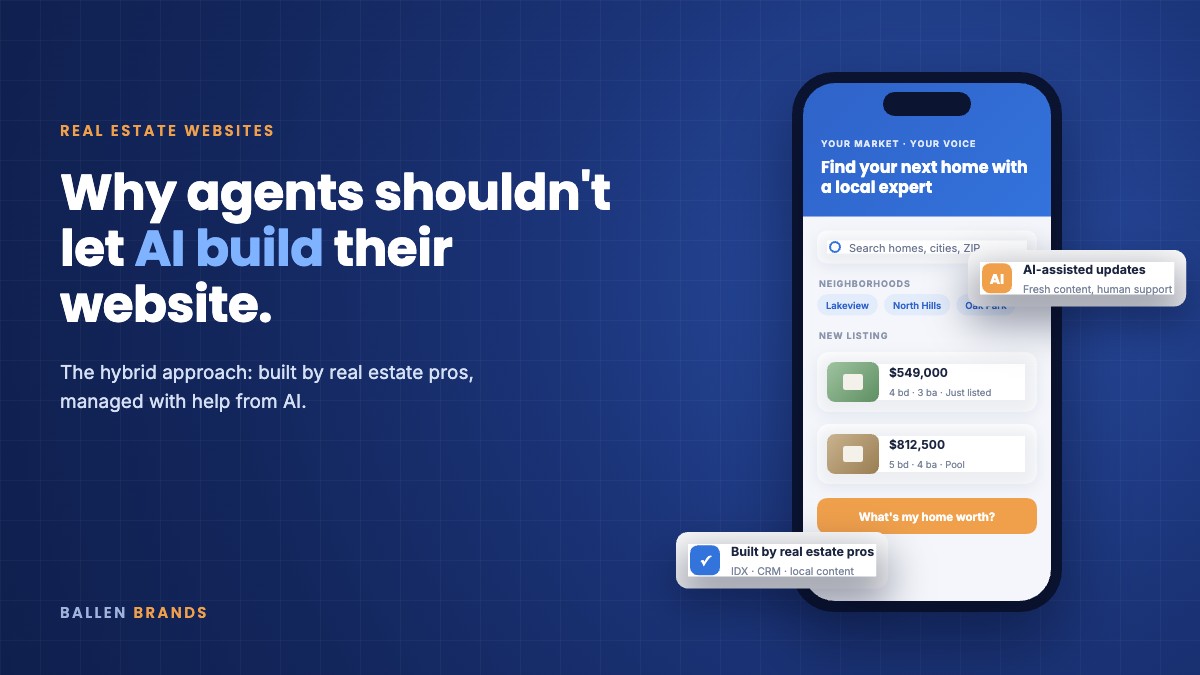
That’s why we take a hybrid approach. Think of it like a hybrid vehicle: two power sources working together, each doing what it does best. We build your site on a proven, flexible platform, bringing the real estate know-how, IDX integration, and CRM setup that AI can’t deliver on its own. Then AI helps you manage it, from drafting blog posts to refreshing community pages and keeping your content current. And when you need a human, our team is a phone call away. You get the best of both worlds.
At Ballen Brands, we build real estate websites tailored to each agent, with IDX integration, CRM setup, content, and hosting handled for you. If you’re weighing a DIY site against a professional one, explore BREW, our real estate website and marketing platform, or book a free, no-obligation consultation. Call Ballen Brands at +1 (702) 917-0755 or email team@ballenbrands.com, and we’ll show you how a hybrid website can work for your business.
BREW Real Estate Website & Marketing Platform
Ballen Real Estate Websites were built by agents, for agents real-time in the field… and without any contracts!