
Let’s be honest about something most website companies won’t tell you: adding IDX to your website won’t make it outrank Zillow, Realtor.com, or your brokerage’s site. Those sites have enormous budgets, millions of pages, and years of search history. Trying to beat them at general home search is a losing game.
So is IDX worth it? Absolutely, because it’s one of the most important tools a real estate website can have. IDX can statistically increase your traffic, but not by simply sitting on your site and waiting for buyers. The agents who get results from IDX use it in two ways the big portals can’t copy.
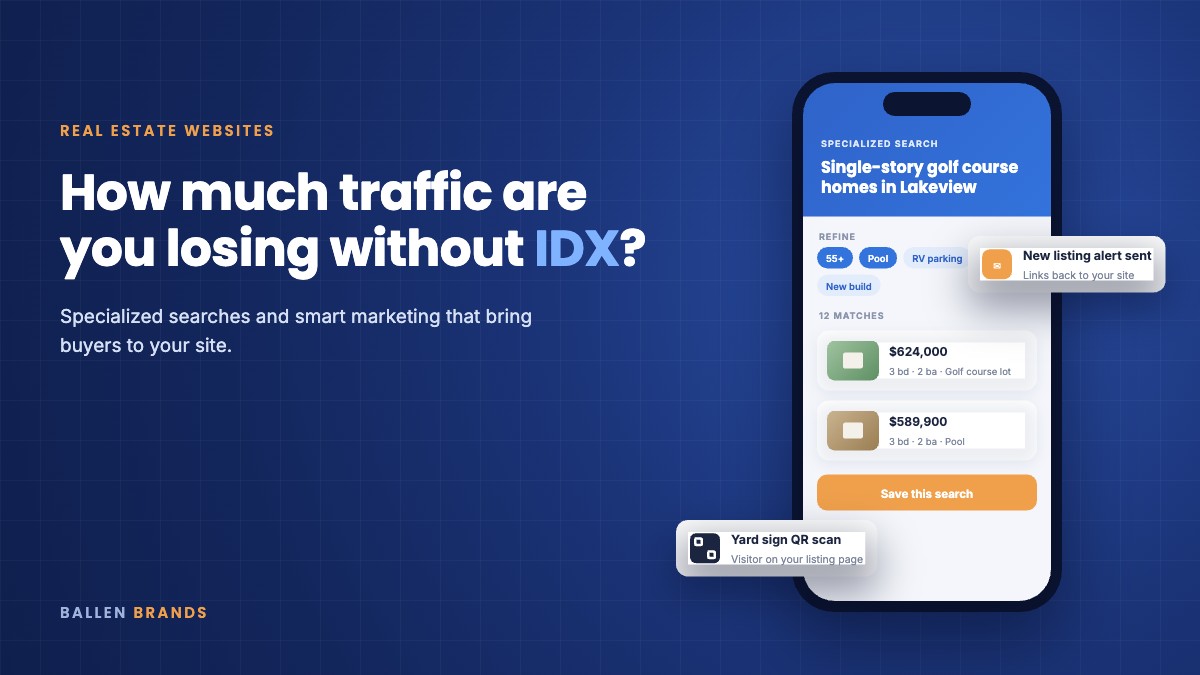
First, they go narrow. Instead of competing on “homes for sale in [city],” they build specialized searches around the neighborhoods, lifestyles, and property types they know best.
Second, they use it to market. Their listings and searches become content they share on social media, in emails, and on printed materials, reaching people who aren’t searching for homes yet but will be soon.
If your website doesn’t have IDX, or has it but doesn’t use it this way, you’re missing both. Here’s how they work.
Go Narrow: Specialized Searches the Portals Don't Offer
IDX (Internet Data Exchange) lets your website display live MLS listings. Every portal has the same listings, so having them isn’t what sets you apart. What sets you apart is how you organize them.
The big sites are built for everyone, which means they’re built for no one in particular. You know your market in a way they never will, and IDX lets you turn that knowledge into custom searches, such as:
- Homes in a specific subdivision, school zone, or zip code
- 55+ and active adult communities
- Golf course, waterfront, or mountain-view homes
- Single-story homes, homes with pools, or RV parking
- New construction in a particular area
- Condos and townhomes under a price point
- Horse property or homes on acreage
- Luxury homes above a certain price
Each of these can live on its own page on your site, alongside your take on the area: what it’s like to live there, what homes typically cost, and what buyers should know. A retiree searching for single-story homes with golf course views in one neighborhood is far more likely to find, and trust, a page built for exactly that than a general search on a giant portal.
Specialized searches also give buyers a reason to come back. They can save the search, get alerts when a new match hits the market, and return to your site every time one does. Over time, these focused pages can bring in visitors who are looking for exactly what you specialize in, which is the kind of traffic that actually turns into clients.
BREW Real Estate Website & Marketing Platform
Ballen Real Estate Websites were built by agents, for agents real-time in the field… and without any contracts!
Market With IDX to Reach People Who Aren't Searching Yet
This is where IDX really pays off. Most future buyers and sellers aren’t on a home search site today. They’re scrolling social media, checking email, and walking past yard signs. They might be renting and wondering if they could afford to buy, or a homeowner curious about what the house down the street sold for.
The portals only reach people once they start searching. You can reach them before that, and IDX gives you something worth sharing. Every listing and specialized search on your site has its own page, so all of your marketing can point people back to your website, where they can look around, save a search, and get to know you.
Social media posts
When you share a new listing, a price drop, or an open house on Facebook, Instagram, or LinkedIn, link to the listing page on your own site. Followers who click land on your website, where they can see the full details, browse similar homes, and save a search. Without IDX, that same post usually sends them to a portal, where the next agent’s ad is waiting.
Neighborhood posts work the same way. A quick video about a community you serve can link to that community’s page, with live listings right there.
QR codes
QR codes connect your offline marketing to your website. Put them on yard signs, flyers, postcards, open house sign-in sheets, and listing brochures. A buyer standing in front of a home can scan the code and land on that listing on your site, along with every other home for sale in the neighborhood.
A QR code on a “Just Sold” postcard can link to current listings in that area or to your home valuation page, so curious neighbors end up on your website too.
Drip email marketing
IDX turns your email list into a steady source of return visits. Saved-search alerts send buyers new matches automatically, and every alert links back to your site. You can also send emails to your database through your CRM featuring specific listings, such as a “just listed in your neighborhood” announcement, an open house invite, or a hand-picked set of homes, with each one linking back to that listing on your site.
Each email is a reason to come back, and each click is another visit to your website, not someone else’s.
And more
The same idea works almost anywhere you market yourself:
- Text messages with links to new listings for active buyers
- Your email signature, linking to your home search
- Google Business Profile posts featuring new listings
- Open house follow-ups linking to similar homes
- Video descriptions on YouTube linking to the homes and neighborhoods you feature
Each of these reaches people who weren’t actively looking for an agent, and turns casual interest into a visit to your website instead of a portal’s.
You Don't Have to Beat the Portals
The goal isn’t to become the next Zillow. It’s to make sure the people who come to know you, through a post, a postcard, a referral, or a specialized search, have a reason to stay on your website.
Without IDX, even your best marketing has a leak. Someone sees your post about a new listing, wants to look at more homes, and has nowhere to go on your site. So they open a portal, where the next agent’s ad is waiting. Many agent sites without true IDX even have a “Search Homes” button that sends visitors to a brokerage site or third-party portal. It feels like a feature, but it’s really an exit.
With IDX, you keep that interest. The buyer keeps browsing on your site, saves a search, and hears from you. You’re not competing with the portals for every home shopper online. You’re keeping the people you’ve already reached, which is why owning your own IDX website matters.
Real Estate Website Content Services
Ballen Brands uses tested and proven methods in our blogs that have been proven to increase search engine ranking thus providing a higher opportunity for getting more leads on your website.
Signs Your Website Is Leaving Traffic on the Table
Not sure whether this applies to you? Pull up your website and your analytics, and check for these:
- Visitors can’t search homes without leaving your site. No search, or a search button that opens another website.
- Your marketing links go to portals. Your social posts, emails, and flyers send people to someone else’s site to see the homes.
- You have no pages for your specialties. Nothing on your site speaks to the neighborhoods, lifestyles, or property types you know best.
- Most visitors come once and never return. A low share of returning visitors usually means there’s nothing new to come back for.
- No one can save a search or get alerts from you. Buyers have no way to keep in touch with your site between visits.
- Leads mostly come from referrals and ads, not your website. Your site should be one of your lead sources, not just a place people check you out after someone else sends them.
If you checked two or more, IDX is one of the most important upgrades you can make.
Setting Up IDX So It Works for You
Adding IDX isn’t a magic switch. How it’s set up decides whether it actually helps you grow. Here’s what makes the difference.
Listings search engines can read
Some IDX tools display listings inside a frame, so the listings technically appear on your site but search engines credit them to the IDX provider instead of you. That gives visitors a search tool but does little for your traffic. A search-friendly setup puts listing and search pages on your own domain, where they can be found and ranked.
Community pages built around your market
Listings alone are only part of it. The sites that win local searches pair IDX with neighborhood and community pages: what it’s like to live there, what homes cost, schools and amenities, and live listings for that area on the same page. Those pages answer the questions buyers are actually searching and keep them on your site while they look.
Lead capture that fits the search experience
More traffic only matters if it turns into conversations. Good IDX setups ask visitors to create a free account to save homes or set alerts, at the moment they’re most interested. That turns anonymous browsers into named leads without feeling pushy.
Built and supported by people who know real estate
IDX setup involves MLS agreements, display rules, and ongoing updates. Working with a team that practices real estate and builds IDX websites every day means you don’t have to learn any of that yourself, and someone is there to help when you need it.
The Bottom Line
IDX alone won’t make your website outrank the national portals, and it doesn’t need to. Its real value is in how you use it: specialized searches built around the markets you know best, and marketing that brings people to your site before they ever open a home search app.
Used that way, IDX is one of the most important features a real estate website can have. It turns your listings into a reason to visit, your marketing into traffic you keep, and your website from a digital business card into a steady source of new clients.
At Ballen Brands, IDX integration is one of our core offerings. We build real estate websites tailored to each agent on our BREW real estate website and marketing platform, with IDX, CRM setup, content, and hosting handled for you. Then AI helps keep your content fresh, and our team is a phone call away when you need a human.
Curious how IDX could work for your market? Book a free, no-obligation consultation. Call Ballen Brands at +1 (702) 917-0755 or email team@ballenbrands.com, and we’ll walk through what IDX could do for your business.
BREW Real Estate Website & Marketing Platform
Ballen Real Estate Websites were built by agents, for agents real-time in the field… and without any contracts!