
A real estate website can feel like a big decision, especially when the price tag makes you pause before anything else. That hesitation is understandable. A professional website is tied to your brand, your leads, your listings, your content, your search visibility, and the way potential clients experience your business online. When you are deciding whether the timing is right, the question is really about readiness. Are you prepared to use a website as a working part of your business, or are you only looking for a digital placeholder?
The right website can support your marketing long after the first launch date. It can give your content a home, help buyers search listings, provide sellers with useful resources, connect visitors to your follow-up systems, and give your business a stronger online foundation. Before you invest, it helps to look at your goals, your capacity, your current marketing gaps, and the long-term role you want your website to play.
What Problem Do You Need Your Real Estate Website to Solve?
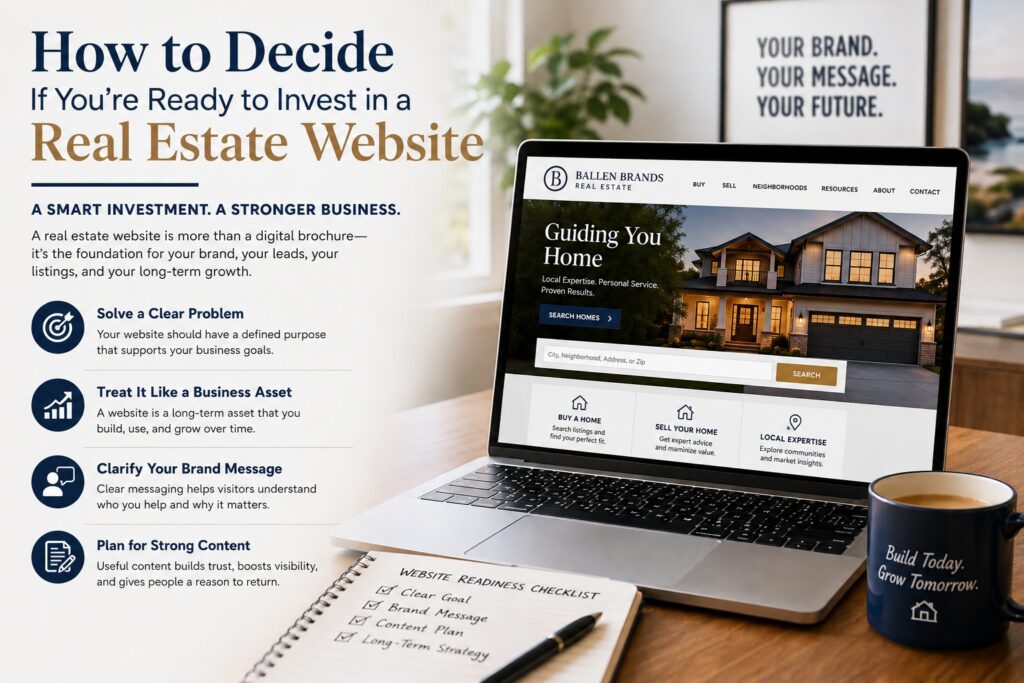
Your website should solve a clear business problem before you invest in building one. A professional real estate website works best when it has a defined purpose, as that purpose guides its structure, content, tools, and user experience.
Start by looking at what feels scattered or missing in your current online presence. You may have social media profiles, listing links, brokerage pages, landing pages, email tools, and saved resources in different places. Each piece may serve a purpose, yet the overall experience can feel disconnected when a potential client tries to understand who you are, what you do, and how you can help.
A real estate website can bring those pieces together. It can become the place where buyers search homes, sellers learn about the selling process, past clients reconnect with you, relocation clients explore local areas, and leads find a clear next step. When the website has a defined job, the investment becomes easier to evaluate.
For example, if your main challenge is buyer lead generation, your website may need strong IDX search, community pages, saved search options, and calls to action that invite buyers to take the next step. If your main challenge is seller education, your website may need strong content around home value, pricing, preparation, local market conditions, and listing strategy. If your challenge is brand credibility, your site may need a polished design, testimonials, service pages, and local expertise.
A website without a purpose can feel expensive because the value feels unclear. A website with a purpose gives every page, button, form, and feature a reason to exist. That clarity helps you decide whether you are ready to invest and what kind of website your business actually needs.
Are You Ready to Treat Your Website Like a Business Asset?
You are ready to invest when you view your website as a long-term business asset rather than a one-time design project. A professional website is something you build, use, improve, and rely on as part of your marketing system.
A real estate website can support your business for years when it is treated with intention. The design matters, but the real value lies in the structure behind it. Your website can host your content, integrate with lead-capture tools, support your IDX real estate search experience, organize your local expertise, and provide potential clients with a place to return when they need information.
This mindset matters because a website does not become valuable only because it exists. It becomes valuable when you use it consistently. That may mean publishing blogs, building community pages, adding buyer and seller resources, sharing website links in your social posts, sending email subscribers back to useful pages, and reviewing your site as your business grows.
A website is also one of the few marketing assets you can shape around your own brand. Social platforms may help you reach people, but your website gives you a central place where your message, content, services, and next steps can live together. That kind of ownership is important for real estate professionals who want a stronger digital footprint.
Readiness often comes down to how you plan to use the site after launch. If you want a pretty homepage and nothing else, the investment may feel heavy. If you want a home base for content, search, lead capture, local expertise, and long-term visibility, the investment begins to make sense. A website earns its place in your business when it supports the work you are already doing and gives it a permanent home.
Do You Have a Clear Brand Message?
A clear brand message helps your website feel focused, trustworthy, and easy to understand. Before you invest, you should know what you want people to understand about your business when they land on your site.
Your website should quickly answer a few important questions for visitors. Who do you help? What areas do you serve? What type of real estate support do you provide? What makes your approach useful, reassuring, or valuable? The answers do not need to feel complicated, but they do need to feel clear.
Many real estate professionals know their value in conversation, yet that value may feel harder to express online. You may be excellent at guiding first-time buyers, helping sellers prepare a home, serving relocation clients, working with luxury properties, supporting investors, or explaining local market conditions. Your website should make that expertise visible.
Your brand message should also reflect your business’s tone. Some agents want a polished, luxury feel. Some want a warm, community-centered presence. Some want a practical, educational approach. Some want a modern, high-performance lead-generation site with robust IDX search and clear conversion paths. Your message helps shape that direction before the website is built.
Without clear messaging, a website can become a collection of pages that look nice but say very little. With clear messaging, the site can guide visitors from curiosity to confidence. Buyers and sellers should feel that they have arrived in the right place and that the next step is simple.
You do not need every sentence written before you invest. You do need enough clarity to guide the build. When you understand your audience, your market, your services, and your point of view, your website can reflect your business with confidence instead of guesswork.
Are You Prepared to Support the Website With Content?
A website needs useful content to become a stronger marketing tool over time. Design creates the first impression, while content gives visitors a reason to stay, learn, search, trust, and return.
Real estate content can take many forms. Buyer guides, seller guides, neighborhood pages, community overviews, relocation resources, market updates, home preparation tips, financing explanations, and listing strategy articles can all help your website serve real people with real questions. Strong content also gives search engines and AI tools clearer information about what your site covers.
Before investing, think about whether you are ready to support your website with content yourself or work with a team that can help. You do not need to publish constantly, but a site with no content plan can stall quickly. Your website may launch beautifully, yet it needs depth to grow into a resource.
Content also gives your marketing a stronger foundation. Instead of sending people only to social posts, you can send them to a full article, a community page, a property search page, or a helpful resource. That creates continuity across your website, email marketing, social media, and lead follow-up.
For real estate agents, content is especially valuable because clients often have questions long before they are ready to call. A buyer may research closing costs, neighborhoods, schools, commute times, or mortgage basics. A seller may research repairs, pricing, staging, or market timing. Your website can meet those people early in the decision process.
Readiness means understanding that content is part of the investment. A website without content may still look professional, but content helps it become useful. When your website answers questions and supports decisions, it can work as an educational resource and a credibility builder at the same time.
BREW Real Estate Website & Marketing Platform
Ballen Real Estate Websites were built by agents, for agents real-time in the field… and without any contracts!
Do You Need Better Lead Capture and Follow-Up?
You are ready for a stronger website when you need a better way to capture leads and continue the conversation after visitors leave. A professional real estate website should help turn attention into opportunity through clear forms, search tools, calls to action, and follow-up connections.
Visitors often arrive at a real estate website with different levels of intent. Some are actively searching homes. Some are casually browsing neighborhoods. Some are thinking about selling in the future. Some are comparing agents before reaching out. Your website should provide each type of visitor with a clear path forward.
Lead capture can include home search registration, saved searches, listing alerts, home valuation requests, consultation forms, downloadable resources, newsletter signups, and contact forms. These tools help visitors raise their hands in different ways. A buyer may feel comfortable saving a search before booking a call. A seller may request a value estimate before discussing a listing appointment.
Follow-up matters because many website visitors are not ready to act immediately. A strong website can work alongside email tools, CRM systems, and nurture campaigns so leads do not disappear after the first visit. When your website connects to your follow-up process, it becomes part of a larger client journey.
This is where planning matters. A beautiful website with weak lead capture can miss opportunities. A website with thoughtful lead paths can support your business even when visitors are still early in their decision-making process.
You may be ready to invest if your current online presence attracts attention but offers no reliable way to continue the relationship. A website should create a bridge between interest and conversation. When visitors can search, learn, subscribe, request information, and reach out easily, your website becomes a stronger part of your business development system.
Is Your Current Online Presence Holding You Back?
You may be ready to invest when your current online presence no longer reflects the level of business you want to attract. Your website, profiles, search results, and online materials all shape how people experience your professionalism before they ever speak with you.
A weak or outdated website can create friction. Visitors may struggle to find listings, learn about your services, understand your market expertise, or contact you. Pages may load slowly, feel generic, lack local depth, or send people to disconnected tools. Even when your offline service is excellent, your online presence may fail to communicate that quality.
Real estate clients often conduct research before contacting. They may look you up after seeing a sign, hearing your name, receiving a referral, finding a social post, or meeting you in person. When they search for you, your website should help reinforce confidence. It should give them a clear picture of your knowledge, service areas, resources, and next steps.
An outdated online presence can also make your marketing harder. If you do not have a strong website, you may have nowhere meaningful to send people from social media, email, printed materials, QR codes, listing flyers, or ads. That creates a gap between visibility and action.
A professional website can help close that gap. It gives your brand a central place to live and gives your marketing a destination. It can also help organize your local expertise in a polished, easy-to-navigate way.
The key question is whether your current online presence supports the business you are building. If your website feels disconnected from your goals, your market, or your client experience, that may be a sign that the timing is right.
Are You Ready to Invest in IDX Search?
IDX search is worth considering when you want your website to support serious buyer activity. A real estate website with IDX can give visitors a way to search for active listings directly on your site, helping keep the home search experience connected to your brand.
For buyers, property search is often one of the main reasons they visit a real estate website. They want to browse homes, compare areas, review prices, look at photos, and understand what is available. When your site includes IDX search, those actions can happen within a space tied to your business, rather than sending visitors elsewhere.
IDX can also support lead capture. Saved searches, listing alerts, property inquiries, registration prompts, and search behavior can create opportunities for follow-up. When used thoughtfully, IDX helps connect buyer curiosity with your communication system.
Before investing in IDX, it helps to understand your goals. If your business depends heavily on buyers, relocation clients, neighborhood search, or local property discovery, IDX may be an important part of the website strategy. If your site is mainly focused on seller content or brand credibility, IDX may still have value, but the role may be different.
IDX works best when paired with a strong site structure and content. Community pages, neighborhood guides, buyer resources, and clear search paths can help visitors move naturally between learning about an area and viewing available homes. The search tool becomes stronger when the rest of the website supports the experience.
You are ready to invest in IDX when you want your website to serve as a practical home search destination, not only a brochure for your services. When buyers can search, save, inquire, and return, your website becomes a stronger part of the buyer journey.
Real Estate Website Content Services
Ballen Brands uses tested and proven methods in our blogs that have been proven to increase search engine ranking thus providing a higher opportunity for getting more leads on your website.
Do You Have a Plan for Local Visibility?
A real estate website is stronger when it includes a plan for local visibility. Buyers and sellers often search by city, neighborhood, lifestyle, price point, school area, commute route, property type, and local questions, so your website should be built with those search behaviors in mind.
Local visibility starts with useful pages that reflect the areas you serve. Community pages, neighborhood guides, market resources, school-area content, relocation pages, and local buyer or seller articles can all help your website become a richer resource. These pages also give you helpful links to share in emails, social posts, conversations, and listing materials.
Search visibility takes time, but structure matters from the beginning. A website should make it easy for visitors and search engines to understand your service areas, specialties, and content topics. That means clear navigation, logical page organization, quality writing, internal links, and helpful information that answers real questions.
For real estate professionals, local content can also support authority. When your website explains neighborhoods, lifestyle factors, home styles, transportation, market considerations, and buying or selling decisions, visitors can see that you understand the area beyond the listing data. That kind of depth can help build trust.
A website without a local visibility plan may still look attractive, but it may struggle to support search, content marketing, or long-term growth. A website with a local visibility plan can become a stronger foundation for online discovery.
You are ready to invest when you know which markets matter to your business, and you want your website to reflect that focus. The stronger your local strategy, the easier it becomes to build pages and content that support your long-term online presence.
Can You Commit to Using the Website After Launch?
Your website will serve you best when you actively use it after launch. A real estate website should become part of your daily, weekly, and monthly marketing routine, rather than sitting untouched once the design is finished.
Using your website does not have to mean complicated technical work. It can mean sharing blog posts on social media, linking to community pages in emails, sending buyers to saved search pages, sending sellers to preparation resources, reviewing forms and lead paths, adding new content, updating service pages, and ensuring your calls to action still align with your goals.
A website becomes stronger when it stays connected to your business activity. If you create a social post about first-time buyers, you can direct people to a more comprehensive buyer resource on your website. If someone asks about a neighborhood, you can share a community page. If a seller wonders what to do before listing, you can send a helpful preparation article. Each use reinforces the website as your central resource.
After launch, you may also need small updates over time. Markets shift, services change, team members change, offers evolve, and content opportunities appear. A website that can grow with your business gives you room to keep improving your online presence.
Readiness includes the willingness to incorporate the website into your workflow. You do not need to become a web expert. You do need to see the site as something active. When you use it consistently, it can support your conversations, marketing, education, lead capture, and credibility.
A launch date is the beginning of the website’s role in your business. The real value grows as you keep using the site as a working part of your marketing system.
Does the Investment Fit Your Current Business Stage?
The right time to invest depends on your goals, budget, workload, and growth stage. A real estate website should feel like a strategic move, not a rushed purchase made because you feel pressured to keep up with every marketing trend.
If you are newly licensed, you may need a website that establishes credibility, explains your services, introduces your market, and gives prospects a clean place to learn about you. If you are established, you may need a stronger site that supports content, IDX search, lead capture, referrals, and ongoing visibility. If you are growing a team, you may need a website that organizes agents, services, listings, resources, and market coverage.
Budget matters, but readiness is not only about whether you can pay for the build. It is also about whether the website aligns with your business’s direction. A professional website may be the right next move when you already know you need a stronger digital foundation, better lead paths, stronger content visibility, or a clearer brand experience.
It may be worth waiting if you have no clear market focus, no service direction, no plan to use the site, or no bandwidth to support it after launch. Waiting does not mean avoiding the investment forever. It can mean taking time to clarify your goals so the build is stronger when you are ready.
A website should support the business you are actively building. When your goals are clear, and your current tools feel limited, the investment can make practical sense. When you understand what the website needs to do, how you will use it, and how it fits into your growth plan, you are in a stronger position to move forward with confidence.
How Can Ballen Brands Help You Build the Right Real Estate Website?
Ballen Brands can help you turn your real estate website into a stronger digital foundation for your business. The goal is to build a website that looks professional, supports your marketing, and provides a useful platform for buyers and sellers to connect with your brand.
A real estate website should be planned around the way your business actually works. That includes your service areas, your audience, your lead-capture needs, your content goals, your IDX real estate website strategy, and the follow-up systems you want to connect with. Ballen Brands can help bring those pieces together so your website has structure, purpose, and room to grow.
For agents seeking buyer activity, IDX can play an important role by giving visitors a place to search for available homes directly on your website. For agents looking for stronger content visibility, blog posts, community pages, and buyer or seller resources can help build a deeper online presence. For agents who need better lead flow, forms, calls to action, and connected tools can help move visitors toward the next step.
The value of a professional website comes from how the pieces work together. Design, content, IDX, search visibility, lead capture, email follow-up, and ongoing support all contribute to the experience. When those elements are carefully planned, your website can become a reliable home base for your marketing rather than another disconnected tool.
If you are deciding whether now is the right time to invest, Ballen Brands can help you assess your goals and determine which website makes sense for your business. A free, no-obligation consultation can help you clarify your options, ask questions, and decide whether a professional real estate website is the right next step. To get started, reach out to Ballen Brands at 702-917-0755 or team@ballenbrands.com
BREW Real Estate Website & Marketing Platform
Ballen Real Estate Websites were built by agents, for agents real-time in the field… and without any contracts!