Your real estate business depends on digital visibility to attract clients, build trust, and generate leads. Platforms, portals, and broker-provided websites can deliver exposure, but they operate within systems that shift, evolve, reset, or disappear. Owning your real estate website gives you a stable foundation that supports long-term growth, brand continuity, and strategic control. When your website belongs to you, every piece of content, every visitor interaction, and every data point works together to strengthen your business over time.
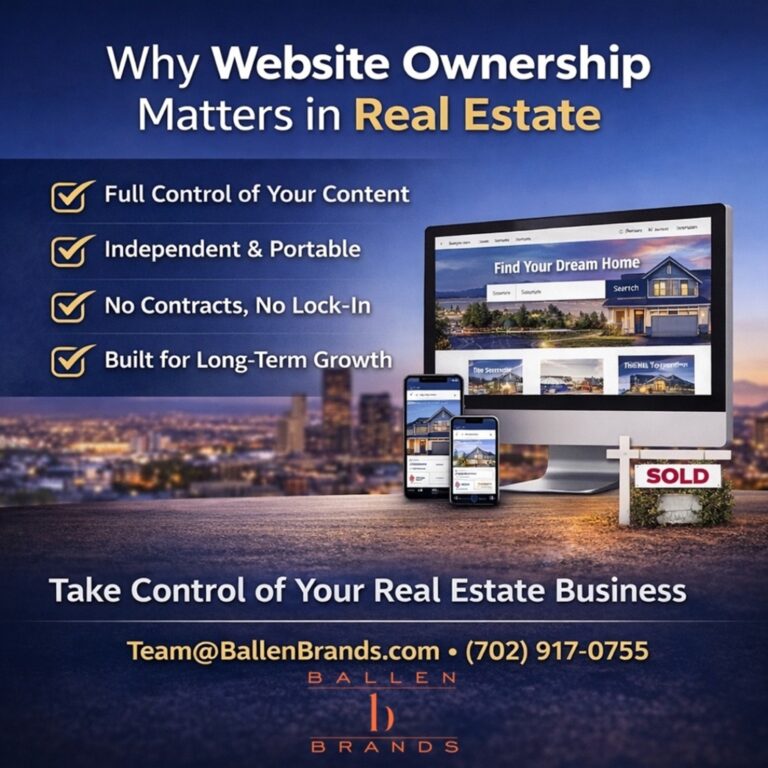
What Does It Mean to Own Your Real Estate Website?
Owning your real estate website means you control the foundation on which your business is built. You own the domain name, decide where the site is hosted, and have full authority over how it is structured, branded, and expanded over time. Every page, every piece of content, and every visitor interaction belongs to you, not to a platform, provider, or third party.
True ownership also means freedom of choice. You decide how your website is organized, what content is published, and how that content is optimized for search visibility. You are not limited by preset templates, restricted page types, or rules that prevent you from fully showcasing your expertise, your market knowledge, or your brand voice. Your website can grow alongside your business, rather than forcing your business to fit into someone else’s system.
Data control is another critical part of ownership. When you own your website, you have direct access to analytics, visitor behavior, lead activity, and performance insights. This information helps you understand how people find you, what content resonates, and where improvements yield stronger results. That data stays with you, providing long-term insight rather than disappearing when tools or platforms change.
Ownership also creates continuity. Your website remains intact regardless of changes in technology, marketing trends, or professional affiliations. Content continues to build authority, search visibility strengthens over time, and your digital presence compounds instead of resetting. Each update, blog post, and community page adds lasting value rather than serving a temporary purpose.
At its core, owning your real estate website means building on land you control. It gives you stability, flexibility, and confidence that the work you put into your online presence continues working for your business year after year.
What Happens to Your Website If You Change Brokerages?
Many real estate agents begin with a website provided through their brokerage. These sites often feel personal and permanent, especially after time is spent adding pages, writing blog posts, and building local content. The important detail is ownership. In many cases, broker-provided websites are licensed for use, not owned by the agent. The brokerage controls the domain, hosting, and underlying platform, even though the site carries the agent’s name and branding.
When a brokerage change occurs, the outcome of that website depends entirely on the brokerage’s policies. Some sites are turned off immediately. Others are reassigned, archived, or repurposed. Content created over months or years may remain with the brokerage, including blog posts, community pages, and the search visibility those pages built. Even when limited content transfers are allowed, the structure and SEO value often stay behind.
This scenario surprises many agents because it is rarely discussed up front. The website feels like a personal business tool, yet the control rests elsewhere. That lack of portability disrupts during a period of transition. A new brokerage affiliation brings enough change on its own, and losing a website and its content adds unnecessary complexity.
Owning your website removes this uncertainty. When the domain, hosting, and content belong to you, your online presence stays intact regardless of where you hang your license. Your website moves with you, your content continues to work, and your search visibility remains tied to your brand rather than a brokerage relationship.
For agents thinking long-term, this distinction protects the time, effort, and expertise invested in building an online presence and ensures that growth carries forward through every stage of a real estate career.
Why Can't Third-Party Platforms Replace an Owned Website?
Third-party platforms cannot replace an owned website because they provide visibility without giving you control over the foundation. In real estate, these platforms generally fall into three distinct categories: brokerage-provided websites, platform-based websites offered through technology vendors, and national listing portals. Each serves a purpose, but none function as a true owned asset.
Brokerage-provided websites are tied to your brokerage relationship and were addressed earlier. When that relationship changes, the website and its content often stay behind because the brokerage controls the domain, hosting, and platform.
Platform-based websites are different, but they come with their own limitations. These are websites built through real estate technology companies that bundle a website into a larger system, such as a CRM or marketing subscription. Examples include platforms such as kvCORE, BoomTown, and Sierra Interactive. In these cases, you may pay for the service, add content, and customize certain elements, but the underlying framework remains the platform provider’s. Page structures, URL formats, navigation, and technical SEO settings are often locked into that system. If you leave the platform, the site typically cannot be transferred in full. Content may be exported, but the structure and search authority usually are not.
National listing portals operate in a fundamentally different way. Sites such as Zillow and Realtor.com are built as large consumer marketplaces. They first attract buyers and sellers, then organize agents and listings within that environment. Your agent profile is not a standalone destination. It appears alongside many other agents, often on the same property pages. The platform controls which agents are shown, how profiles are displayed, what calls to action appear, and how leads are routed. Even when a lead reaches you, the experience began inside a system designed to retain the consumer on the platform rather than to build your brand.
Social media platforms introduce different limitations, but they also serve a valuable role when used intentionally. Content appears briefly in a feed, then is replaced by newer posts. Visibility depends on algorithms, and posts are not organized as permanent, searchable resources. Over time, even strong content becomes difficult to locate again once it moves out of active circulation.
Where social media excels is amplification. These platforms are effective for sharing links to blog posts, community guides, market reports, and educational resources that live on your website. Instead of trying to hold all your content in a feed, social media works best when it directs traffic back to your own pages. A blog post shared on social media can continue generating traffic and leads long after it stops appearing in timelines, because the destination remains intact.
When your website serves as the home base, social media becomes a connector rather than a container. Posts introduce topics, spark interest, and guide visitors back to in-depth content designed to answer questions, capture leads, and support long-term search visibility.
Third-party platforms can support exposure and distribution. An owned website provides stability, independence, and long-term value that those platforms are not designed to offer.
BREW Real Estate Website & Marketing Platform
Ballen Real Estate Websites were built by agents, for agents real-time in the field… and without any contracts!
How Do Algorithm Changes Affect Your Real Estate Business?
Algorithm changes affect your real estate business by altering the rules of visibility without requiring more effort from you. Content, profiles, and listings can suddenly reach fewer people, appear in different places, or stop being prioritized, even when nothing about your strategy has changed.
On social media, algorithms determine which posts are shown, how long they remain visible, and how often they are resurfaced. These systems are adjusted regularly to favor new formats, paid promotion, or shifting engagement goals. When that happens, posts that once drove traffic or leads may see reduced reach overnight. Past content does not regain visibility unless it is reshared, boosted, or reformatted, which requires ongoing effort to maintain momentum.
On national real estate portals, algorithm changes affect placement rather than posts. Adjustments to agent ranking, profile visibility, lead distribution, or paid exposure can change how often your name appears next to listings or search results. Even small interface or ranking changes can influence which agents consumers see first and which profiles receive the most inquiries.
What makes these changes challenging is timing. Algorithm updates are rarely announced in advance, and they are designed around platform performance, not agent stability. Visibility becomes variable, and lead flow can fluctuate as a result.
An owned website is impacted differently because it is built around intent rather than distribution. Your pages are designed to answer specific questions buyers and sellers are actively seeking, such as neighborhood details, relocation guidance, or market conditions. When those pages are indexed and organized correctly, they continue to surface based on relevance and authority rather than feed placement or profile ranking.
Algorithm changes still occur in search, but their effects are gradual rather than abrupt. Content that is well structured, locally focused, and regularly maintained tends to retain visibility over time. Instead of reacting to constant shifts, you are building a body of work that compounds.
This difference matters for consistency. Platforms can amplify content quickly, but that amplification is temporary. Your website provides a stable layer beneath that activity, so changes in visibility do not erase progress. When platforms fluctuate, your website continues serving as a reliable source of traffic, leads, and credibility.
Why Is an Owned Website a Long-Term Business Asset?
An owned website becomes a long-term business asset because the work you put into it continues to build value over time. Every page you publish, every update you make, and every piece of content you refine adds to a growing digital foundation that supports your business year after year. Unlike short-lived posts or profiles, your website accumulates authority rather than resetting.
Search visibility compounds when content lives on a website you own. Blog posts, community pages, relocation guides, and market reports are indexed, revisited, and strengthened as they age. As search engines recognize consistent relevance and local expertise, your website earns trust and visibility that does not disappear when a platform changes direction. This creates a steady stream of inbound traffic from people actively seeking the information you already provide.
Brand strength also grows through ownership. Your website allows you to present your expertise, messaging, and market knowledge cohesively. Visitors experience your business through a clear structure rather than fragmented posts across multiple platforms. Over time, that consistency builds familiarity and credibility, which directly supports lead generation and conversion.
An owned website also adapts as your business evolves. You can expand into new markets, add new services, publish deeper educational content, or refine your strategy without starting over. The site grows alongside your career rather than forcing your business to fit within preset limitations. Each improvement builds on what already exists, preserving momentum rather than replacing it.
Viewed this way, a real estate website functions like a digital property. It holds value because it is controlled, maintained, and improved over time. When your website is treated as an asset rather than a temporary marketing tool, it becomes one of the most reliable foundations your business can have.
Real Estate Website Content Services
Ballen Brands uses tested and proven methods in our blogs that have been proven to increase search engine ranking thus providing a higher opportunity for getting more leads on your website.
How Ballen Brands Builds Websites You Truly Own
At Ballen Brands, website ownership is built into the foundation of every Ballen Real Estate Website (BREW). Each BREW is created so you own your domain, your content, and your website structure outright, with no long-term contracts tying your business to a platform or provider.
BREWs are built on WordPress, an open-source content management system that allows full control and portability. This ensures your website is never locked into proprietary software or a closed system. Your site can be hosted independently, updated freely, and expanded over time without vendor-imposed restrictions. If your business changes, your website moves with you because it belongs to you.
Search optimization is built into the site from the start. Every Ballen Real Estate Website includes Yoast SEO natively, supporting proper page structure, metadata, indexing, and on-page optimization as content is added. This allows your website to grow with search visibility in mind, without requiring a separate platform or external workaround.
A Ballen Real Estate Website is built as an independent website, not as a licensed platform site or a broker-controlled system. The structure supports long-term search visibility, scalable content growth, and ongoing optimization. There are no usage agreements that limit how your site functions and no frameworks that force a rebuild as your strategy evolves.
Ownership also means flexibility in functionality. BREWs integrate directly with IDX Broker, allowing visitors to search active listings on your website instead of being redirected to third-party portals. This keeps traffic, engagement, and lead activity on your site, where it contributes to long-term value.
Additional tools can be layered onto the website without changing ownership. Integrations with Listings to Leads add home valuation tools, seller resources, and conversion-focused features designed specifically for real estate websites. CRM and marketing automation can be supported by Keap, which connects lead activity across your website and follow-up systems. Visitor behavior and performance insights are provided by Clicky Analytics, offering real-time data on how users interact with your content.
Beyond the core website, Ballen Brands offers optional services that extend the value of a BREW without changing ownership. These include professionally written community pages, hyperlocal content, buyer and seller guides, ongoing content marketing support, and advanced SEO services. Each option is designed to strengthen the website as a long-term business asset rather than a short-term campaign.
The absence of contracts is intentional. Ballen Brands believes your website should stand on performance and value, not obligation. By combining full ownership, an open platform, native SEO support, and flexible integrations, a BREW is built to serve as a stable foundation for your real estate business at every stage.
Conclusion
Owning your real estate website is about protecting your business, your content, and the time you invest in building long-term visibility. When your website is built on a foundation you control, it becomes an asset that supports growth, adapts to change, and remains stable as platforms, algorithms, and tools continue to evolve. Ownership provides continuity, clarity, and confidence that your digital presence is working for you over time.
Ballen Brands builds Ballen Real Estate Websites with that long-term vision in mind. Every BREW is designed for full ownership, flexibility, and scalability, without contracts or platform lock-in. The goal is to create a website that functions as a durable business asset throughout every stage of your real estate career.
If you are ready to take control of your website and build a foundation you truly own, contact Ballen Brands for a free, no-obligation consultation. Reach out by email at Team@BallenBrands.com or call (702) 917-0755 to start the conversation and explore the right solution for your business.
BREW Real Estate Website & Marketing Platform
Ballen Real Estate Websites were built by agents, for agents real-time in the field… and without any contracts!